Posts

Straitjacketing a crisis-2

Continuing from yesterday…( see here ) As I mentioned that the old narratives of the Smoot-Hawley Tariff Act (Tariff protection for domestic businesses), New Deal (Fiscal profligacy to stimulate economy) and Plaza Accord (fiscal and monetary manipulation by government/central banks to balance trade) do not fit the current circumstances, given the vastly different context. The efforts to fit the current U.S. President’s economic actions (and promises) related to trade, tariffs, and fiscal policy into historical molds, don’t align with today’s reality, and may be an exercise in futility. For example, consider the following: ·           In 1930, global trade was 5% of U.S. GDP, and the world economy was already in freefall post-1929 crash. In 2025, trade is a larger share of GDP (e.g., ~25% for the U.S.), but global supply chains are far more integrated, making outright trade wars costlier and less likely. Modern trade agreements (e.g., USMCA, W...

Straitjacketing a crisis

Do you recall Jack Braganza from the popular Hindi movie Bobby (1973)? The affable patriarch wore his marriage suit while visiting the house of Raj, his daughter Bobby’s lover, to discuss their marriage proposal. The suit would not fit him after so many years, but that was perhaps all he had in the name of formal attire. In the movie, this scene created a comic sense. However, in real life it is not uncommon in millions of lower middle-class Indian families. The men use their wedding attire for decades, before they get a new one made, usually for their children’s marriages. The narratives that are being built around, arguably, a blunderous act of the incumbent president of the United States (POTUS), reminded me of this movie scene. Experts are trying to use an old jacket to fit the current scenario, based on their personal perceptions and linkages. Some people, harshly critical of the POTUS, have tried to fit the 1930 trade war triggered by the Smoot-Hawley Tariff Act in 1930 – that wo...

Rewriting History, Unsettling Society: India’s Cultural Clash and Economic Risks

Not long ago, history used to be mostly an academic subject. The educated elite wrote, studied, analyzed, discussed, debated, formed, and altered history as per the available scientific evidence, their perceptions and affiliations. Their perceptions were perhaps deeply influenced by the political narrative and economic concerns of the times. The common people were however mostly concerned with their cultural traditions. These traditions passed through generations, have been generally regarded as history. Popular literature and other art forms, e.g. films, theater, drama, paintings, etc. also had significant influence on the common peoples' perception about history. For common people, the valor of Rajput Kings like Prithviraj Chauhan, Maharana Pratap etc., and sacrifice of queen Padmavati are established through ballads written by poets like Chand Bardai (Prithviraj Raso) and Malik Muhammad Jayasi (Padmavat). Disregarding what academic historians had to say about these legends, peop...

Priests are feasting

Image
The first three weeks of the FY26 have been rather dramatic for the stock markets. By the end of FY25, the benchmark Nifty 50 was down ~10% from its previous high level recorded in September 2024. Foreign investors were selling persistently. News flow from any quarter was not particularly encouraging. Investors’ sentiment was sagging. Market volumes had plunged over 30% from their 2024 highs. The rate of SIP discontinuation had increased materially, with March 2025 recording net negative addition to operative SIPs. Social media timelines of active market participants were filled with despondency. FY26 started with the declaration of trade war by the US. Markets that were already reeling under pressure plunged further, with the benchmark Nifty 50 falling another 9% in the first five trading sessions of FY26. Anecdotal evidence suggests that many traders and small investors capitulated and liquidated their positions. Several others churned their portfolios to move to defensive sectors li...

Focus on affordability quotient not inflation

Image
The rate of Consumer Price Inflation (CPI) in India dropped to 3.34% in the month of March; below the lower bound (4%) of the regulator’s (RBI) target band of 4% to 6%. It is definitely a significant development insofar as the monetary policy consideration, macroeconomic stability, and consumer confidence are concerned. If this trend sustains, it would pave the path for further easing in the monetary policy; improve the fiscal outlook; improve the outlook for debt and currency markets; aid corporate profitability and encourage fresh investment flows. In this sense, it is certainly good news for the investors in Indian financial markets in the near-term. However, in my view, a low inflation rate does not help a large section of the Indian population much. A low inflation rate only implies a slower rise in the price level as compared to the prices in the base period. It offers no relief to the people who are already finding the existing prices of the essential goods and services unaf...

Looking beyond Mr. Bond

Continuing from yesterday… Mr. Bond no longer a superstar Given my view that the yield curve is no longer a strong leading indicator, I prefer to use a mix of indicators to assess the likely direction of the markets. Mortgage rates, credit growth, credit terms, repo outstandings and the size of the central bank’s balance sheet are the most prominent ingredients in the mix I like to use. For example, in the context of the US, Mortgage rates are a close pulse on borrowing costs, consumer behavior, and economic health, less abstracted than the yield curve. In the U.S., the 30-year fixed mortgage rate tracks loosely with the 10-year Treasury yield—historically about 1.5 to 2 percentage points higher—but it’s more than just a derivative. It folds in lender risk appetite, housing market dynamics, and Fed policy fallout in a way that hits Main Street directly. Presently, mortgage rates are climbing—30-year fixed is around 6.8%, up from 6.4% in late March, shadowing that recent 10-year ...

Mr. Bond no longer a superstar

Image
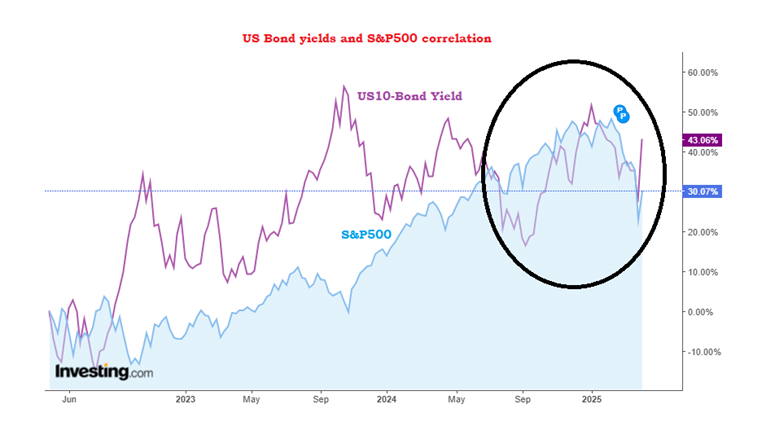
The conventional market wisdom suggests that the bonds usually lead the change in market cycles. Traditionally traders have closely followed the yield curve shape, benchmark (10 year) yields and high yield credit spreads to speculate the near term moves in equity, currency and commodity markets. Two simple reasons for this traditional practice are – (i)     Bond markets are usually more correlated with the economy. (ii)    Size of bond markets is materially larger than the equity, currency and commodity markets. It has the largest number of leveraged positions at any given point in time; and most of the large and influential market participants are more active in bond markets as compared to the other markets. I am however inclined to disregard this piece of conventional wisdom. In my view, it would make sense only if the markets are operating in a free and fair manner. In cases where the central bankers and governments (through Sovereign Wealth Funds and o...

Tariff Tantrums – Where do we stand?

The global markets are shaken by the trade war initiated by the US by announcing arbitrary unilateral tariffs on all of its trade partners. Some large trade partners of the US, like China and EU, have reportedly threatened to join the war with full vigor, making the global market extremely jittery. The prices of most risky assets and commodities have corrected sharply due to fear of widespread economic repercussions resulting in a global recession or even a depression like condition. The benchmark indices in most developed countries have corrected 8% to 18% in the past one month. Commodities, especially metals and energy, have also seen 7%-15% cut. In my view, it may be a little early to assess the short-term impact of the latest events. Things are evolving fast and chances are that better sense would prevail and leaderships of the US and its trade partners would be able to prevent the current stalemate from becoming a game of ego between them; and arrive at a mutually agreed solut...

Tariff Tantrums

Last week, President Trump announced a hike/imposition of tariffs on most of the USA's imports. As per the proposed tariffs that are presently scheduled to come fully into effect from 9 th   April 2025, the Trump administration has proposed a 10% base tariff on all imports into the US. Over and above the base tariff, higher rates of tariff are applicable on several countries based on the trade deficit of the US with each such country. The global reaction to the tariff announcement has been varied. Some trade partners like China have responded aggressively by announcing matching higher tariffs; whereas the others, like India, have adopted a wait and watch approach, hoping to find a middle path. Apparently, the calculation of the proposed indiscriminate tariffs has been done through mindless spreadsheet application, using the recent US trade data. Though President Trump had made tariffs a key issue in his poll campaign, the administration appears mostly unprepared for this. The expla...