(A couple of years ago, one central minister got confused between Isaac Newton and Albert Einstein and erroneously attributed theory of gravity to Einstein. The Enforcement Directorate of Social Media (EDSM) immediately took cognizance of the mistake and forced the minister to correct his mistake. The minister in reference also happened to be a Chartered Accountant by professional qualification, like me. It is reasonable to believe that the minister, like me, does not understand the nuances of the theory of relativity and laws of motion, and got confused. Nonetheless, learning a lesson from that episode, I want to upfront clarify that my knowledge and understanding of the theory of relativity and laws of motion is zilch. Any references to relativity and gravity herein is just plain English and should be read as that only.)
My investment advisor often motivates me to
invest in stocks having “valuation cheaper than the industry average or
significant valuation discount to the industry leader”.
One of the most common investment advices I get
from investment gurus is “invest in quality only”.
I have observed that the most common portfolio
evaluation tool used by the market participants is “returns relative to the
benchmark”. This benchmark could be an index, returns made by some famous large
investor, returns made by a friend or family member, etc.
“Relativity” is thus an important driving force
of the investment strategy.
“Mean reversion” or the gravitational pull
& push of averages is one of the strongest premises in the financial
analysis, especially in the context of investment timing and forecasting
prices. The entire spectrum of technical studies of trends in prices (technical
analysis); future valuation forecasts (long term average of valuations;
standard deviation of valuation parameters etc.); and even earnings forecasts
use the “gravitational pull towards mean” as a key control point in their
operation.
I think there is a need to reimagine the
application of the concepts of “Quality”, “Relativity”, and “Gravity” to the
businesses of equity research, investment advisory and portfolio management.
Quality is good as a noun
"Good is a noun...Good as a noun rather
than as an adjective is all the Metaphysics of Quality is about. Of course, the
ultimate Quality isn't a noun or an adjective or anything else definable, but
if you had to reduce the whole Metaphysics of Quality to a single sentence,
that would be it."- Robert Pirsig in Lila: An Inquiry into Morals
Honestly, how many of us could tell “who is
Kevin Mayer?” without taking the help of St. Google. A mention of Usain Bolt
though may ring many bells. If I mention both names together, most may deduce
that Kevin Mayer is also a sportsperson.
Kevin Mayer is the world champion of Decathlon,
a discipline involving ten track and field competitions. On the other hand
Usain Bold is champion of short distance running (100m and 200m). If someone
asks me “who is better athlete Kevin or Usain?”, my answer would be “it depends
from which vista point I am looking at them!”.
If I am primarily looking for momentary thrill,
excitement and/or extreme competitiveness in sports, I would say Usain Bolt is
better, because his performance sharply raises my adrenalin level, brings me to
the edge of my seat, gives me Goosebumps for 10 to 20 seconds, and then I can
go back to my regular work. I would also enjoy seeing someone winning with
extremely thin margin (fraction of a second) and may derive some motivation to
be highly competitive in my life.
However, if I am looking for an example of
stamina, endurance, consistency, multi-dimensional talent & skills, I would
prefer Kevin. His performance guides me to adopt a balanced approach in life;
as it shows that you do not have to win all the games to be a winner in life.
He could still be a winner by a large margin, even if he performs well in 6 out
of 10 events of the decathlon.
Now apply this analogy to some popular comparisons in stock
market, e.g., Hindustan Unilever & ITC and HDFC Bank and Kotak Bank!

The stock of a company does not necessarily
become “quality” if it is “relatively cheaper”; or it has given “relatively
better returns” over past few years.
I may prefer to invest in a company that has a
sustainable business model; its stock has given 10% CAGR over past 20years,
with low volatility, simply because I can plan my finances with this investment
much better.
Someone else may find quality in a cyclical
business that has just entered an upcycle. The stock of this company may have
given 12% CAGR over past 20years , but with much higher volatility and
unpredictable dividends.
The point I am trying to make here is that
“quality” in relation to investments, like anything else in life, should not be
considered in relative terms. The quality of a portfolio of investments should
be absolute and in congruence with the underlying investment goals.
If my investment goal requires my equity
portfolio to grow by 10% CAGR over next 20years, the quality for me would mean
the portfolio of stocks which have high probability of growing 10% CAGR over
next 20years. Performance of Nifty/Sensex; performance of competitors;
performance of other sectors and markets; performance of alternative assets over
this period should be mostly irrelevant to me.
Relativity may not always apply to stock analysis
There are many models to evaluate the fair
value of a business, e.g., discounted cash flow method, earnings multiplier;
revenue multiplier; replacement value; liquidation value etc. In practice it is
seen that each business has some peculiarity and applying a standard text book
valuation method may not be most appropriate way to find its fair value.
Analysts accordingly modify the standard methods as per their understanding of
the business.
Comparing the relative valuation of two
businesses therefore may not be appropriate in most cases. Nonetheless it is
common to evaluate businesses on relative valuation basis. The worst part is
that analysts use different methods to find the fair value of a business, in
accordance with the size, capital structure, off balance sheet items (eg.,
hidden assets or contingent liabilities) etc.; but often a common parameter is
used to assess the relative valuation of two or more such businesses.
Imagine three pharma companies – one is a large
diversified drug producer with presence in 40 countries; manufacturing branded
generics and formulation; has a decent portfolio of specialty drugs and has a
strong research capability for new molecules; second is a midsized CRAM service
provider to foreign companies and third is a small domestic branded generic
manufacturer with no export revenue. Would it be appropriate to compare these
three businesses on the basis of PE Ratio; EV/EBIDTA; book value or dividend
yield basis?
The businesses like depository services, stock
brokerages, and asset management mostly collect the revenue upfront. The
working capital requirement for these businesses may be negative or negligible.
Comparing these businesses with NBFCs, which have a significantly different
business model, risk profile and cash flows, may be highly inappropriate.
Notably, the global valuation guru Aswath Damodaran,
calculated the fair value of the recently listed food delivery business Zomato
to be Rs40.79 against the IPO price of Rs76 and listing price of Rs116. More
than half the shares issued in IPO exchanged hands on the day of listing;
implying that a large number of discerning investors were willing to pay 2.5x
to 3x of fair value assessed by the guru. The quality and fair valuation obviously
has different connotation for the guru and the market participants.

The mean reversion or gravitation pull &
push for stock prices and valuations has not worked in a large number of cases.
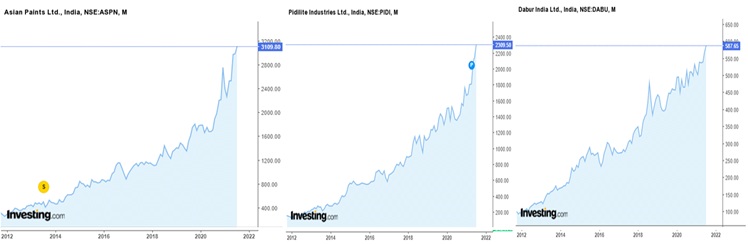
In past one decade, the prices of stocks like Asian paint, Pidilite, Dabur,
etc., have consistently defied the gravitational pull to mean. Similarly, there
is of dearth of stocks that have defied gravitational push to mean despite much
desire of the market participants. Most notable examples of such stocks include
ADAG stocks, JP Group stocks, Suzlon (all part of Nifty in 2008-09). In some
cases however, gravitation force has worked just fine, e.g., PSU Banks.


To conclude, in my view, individual investors
must focus on “quality” of their portfolio in absolute terms not in relative
proportion; set investment goals as per their social, personal and financial
conditions; and evaluate performance of their portfolio in terms of congruence
to their investment goals. This shall make their job much simpler.


