Posts

Showing posts from July, 2025

Powell refuses to toe the Trump line, India stay guarded

  The Federal Open Market Committee (FOMC) of the US Federal Reserve (Fed) maintained its policy rates at 4.25% to 4.5% range, by a majority vote. It was the first occasion since 1993 when two Fed governors voted against the majority decision. Fed governors, Michelle Bowman and Christopher Waller, wanted a 25bps rate cut at the meeting, concluded on Wednesday. The majority decision of the Fed to not cut rates is apparently against the wishes and open demand for a rather drastic cut in the Fed policy rates by the US administration, especially President Trump. Strong April-June quarter GDP data and July private payroll data perhaps weighed on the Fed decision. The Commerce Department’s advance gross domestic product (GDP) report on Wednesday showed growth of 3.0% for the April to June period, above the 2.5% growth expected. US GDP shrank by 0.5% in the January-March 2025 quarter. U.S. private payrolls also increased more than expected July, rising by 104,000 jobs in July 2025 af...

Elephant not in a mood to dance

The current results season (1QFY26) has been rather underwhelming so far. The market expectations for this quarter were already muted. The consensus estimates projected 1QFY26e Nifty50 revenue and profits to grow around 5% yoy, while the broader market earnings were expected to grow at a better 11-12% yoy rate. However, the results declared so far indicate an aggregate revenue growth less than even the nominal GDP growth of ~10%. Besides, the 1QFY26 season reflects a patchy recovery. Select large-cap and government-driven sectors (infrastructure, defense and PLI beneficiaries) have reported decent numbers and growth, while several small and midcap, IT, consumer and media companies have reported below expectation results. In their post results commentary, the management of IT and consumer companies in particular, have highlighted global and macro challenges they are facing, sounding cautious about near-term growth. Banking & Financial Services and IT Services are the most crit...

Two random thoughts

Antimicrobial resistance becoming ominous Antimicrobial resistance (AMR) is fast emerging as one of the most ominous health concerns at global level. As per the  World Health Organization  (WHO), “Antimicrobials – including antibiotics, antivirals, antifungals, and antiparasitic – are medicines used to prevent and treat infectious diseases in humans, animals and plants. Antimicrobial Resistance (AMR) occurs when bacteria, viruses, fungi and parasites no longer respond to antimicrobial medicines. As a result of drug resistance, antibiotics and other antimicrobial medicines become ineffective and infections become difficult or impossible to treat, increasing the risk of disease spread, severe illness, disability and death. AMR is a natural process that happens over time through genetic changes in pathogens. Its emergence and spread are accelerated by human activity, mainly the misuse and overuse of antimicrobials to treat, prevent or control infections in humans, animals and pla...

Living with hubris

For decades, the United States has held a unique place in the global imagination — as the land of opportunity. Its greatest strength may not lie in military might, financial depth, or diplomatic reach, but in its remarkable ability to attract and absorb the best minds from across the world — including from adversarial or war-torn nations. The most striking evidence of this is visible in America’s talent pool. Professionals of foreign origin — Indian, Chinese, Iranian, German, and more — dominate leadership roles across top corporations, academic institutions, legal systems, research labs, and even sensitive government-linked establishments like NASA. Many of these individuals come from countries that have historically suffered at the hands of U.S. military or economic policy — yet they thrive in the American ecosystem, contributing to its innovation, productivity, and geopolitical leverage. This magnetic pull continues despite periodic political rhetoric against immigration, restrictio...

Victory in defeat - When justice becomes a casualty of narrative

In my middle school Hindi book, there was a thought-provoking story titled Haar Ki Jeet (Victory in Defeat) written by Sudarshan. The story was about a compassionate priest, Baba Bharti , living in a village temple. Baba’s only worldly possession was his horse, named Sultan . A notorious dacoit, Khadag Singh , took fancy for Sultan and vowed to take it from Baba . He offered to buy Sultan from Baba . But Baba refused to part with Sultan , whom he had raised like his son. Overcome by desire, Khadag Singh deceitfully stole Sultan from Baba . Kind Baba , did not resist the treachery of Khadag Singh , letting him take Sultan. He, however, requested him not to reveal this incident to anyone. Khadag Singh was baffled by this unusual request of Baba. He asked Baba , “why would you request so?” Baba politely said, “if people come to know about this incident, they may hesitate in helping people in distress”. Moved by Baba’s words and overwhelmed by guilt, Khadag Singh quietly left ...

In search of new leadership-2

Continuing from yesterday…(see   In search of Leadership ) As I see it, the current settings of the Indian economy and market are as follows: Macroeconomic conditions are stable  – inflation is under control, fiscal balance is improving, primary deficit is improving faster leaving room for further fiscal stimulus (may be GST rationalization on the top of income tax concessions already announced); terms of trade may improve as more bilateral trade agreements and free trade agreements begin to yield results; monetary policy is growth supportive – liquidity conditions are comfortable, rates cuts have been frontloaded, and current account position is stable. Financial stability  – The health of the financial system is very good. Bank’s balance sheets are stronger than ever with adequate capital and excellent asset quality. Corporates balance sheets are also stronger with accelerated deleveraging in the past 3 years. The government balance sheet is also improving, against the ...

In search of new leadership

The benchmark indices in India have been directionless for almost two months now. In fact, Nifty50 has yielded a return of less than 2% in the past one year. Broader market indices have also not done any better. However, there has been a significant divergence in the sectoral performances. Some sectors like financials (+13%) and pharma (+8%) have outperformed the benchmark indices in the past one year, sectors like Media (-17%), Energy (-16%), Realty (-13%), FMCG (-7.5%), and Auto (-7.5%) have materially underperformed. In my view, this market performance implies— ·          Fatigue has set in the leaders of the bull market since 2021, especially PSEs, Infrastructure, commodities, and auto. These sectors look tired and unable to lead the market any further. ·          In the past one year, the market has digested (consolidated) the gains of the post Covid-19 rally in the past one year very well. It has...

A method in madness

It is a common adage amongst the financial market participants that “When America sneezes, the rest of the world catches a cold”. The origin of this belief is the global market turbulence in the aftermath of 1929 Wall Street crash. In the past 100 years, whenever the US economy or markets have faced any serious problem, most of the global economies and markets have witnessed elevated volatility and erosion in asset prices. The prime reason for this correlation of the US economy and markets has been the disproportionately large size of the US economy and markets; dominance of the US dollar in global trade; and over-reliance of emerging markets on the US for investment, development assistance and humanitarian aid. In the past couple of years, serious concerns have emerged about the sustainability of the US public debt and fiscal deficit. The overall GDP growth has been aligned to the average of the post global financial crisis (GFC) period. The efforts to accelerate growth have not yield...

A Tremendous Day in the White House – The Best Ever!

  Trump: Hey Susie, you’re looking absolutely fantastic, nobody does it better! How’s the morning going? Did my posts on Truth Social and that failing platform “X” – terrible name, by the way – absolutely ROCK the world last night? Total game-changers! Susie Wiles: Sir, you’re the greatest President in history, nobody even comes close! The entire planet is glued to your accounts. Your posts are sending shockwaves across the universe – markets trembling, governments in a frenzy. We’re doing phenomenal, the best any administration has EVER done! Trump: Fantastic, just fantastic. I knew it! Show me the posts we’re dropping today – we’re gonna dominate! Susie Wiles: Right here, Sir, the absolute best ammo for today’s battle! Trump: Susie, you’re a genius, just brilliant. I love you, you’re tremendous. Fire off a post every 10 minutes, keep ‘em shook! Oh, and send Little Marco in, pronto. Marco Rubio: Good morning, President. How’s the greatest leader in the world doing today?...

India’s US$736.3bn debt challenge: Can it weather a US tariff storm?

  India’s external debt hit US$736.3bn by March 2025, a 10% jump from last year, with a significant portion (over 41%) of the debt maturing soon. As the US threatens 500% tariffs on countries buying Russian oil, including India, investors need to evaluate: Can India afford a confrontation with the US, China and other major trade partners, and could it withstand a covert economic embargo? Here’s my take, may be naïve and ill informed, but nonetheless relevant. India’s External Debt According to the Reserve Bank of India (RBI)  latest release , India’s external debt stood at US$736.3bn at the end of March 2025, with a debt-to-GDP ratio of 19.1%. Key highlights of the data are: Long-Term Debt:  US$601.9bn, up US$60.6bn from last year, with commercial borrowings and non-resident deposits driving growth. About 77% (US$568bn) of this debt is owed by non-government entities. The non-government debt is almost equally divided between financial institutions (US$271.3bn) and non-fin...

US$703bn may be just enough

The Reserve Bank of India holds US$702.78bn in foreign exchange reserves. In the popular macroeconomic analysis, especially in the context of the equity market. this piece of data is often used as one of the points of comfort by analysts. This data could be viewed from multiple standpoints. For example – Is it adequate to pay for the necessary imports in the near term , assuming the worst-case scenario of no exports could be made and no remittances are received. Currently, India’s monthly imports are appx US$67bn. However, a material part of these imports is crude oil and bullion. A part of the crude oil and bullion is re-exported after refining/processing. I am unable to figure out the precise net import number for domestic usage, but it would be safe to assume that about three fourth of US$67bn, i.e., US$50bn is for domestic usage. Allowing another 20% for “avoidable in emergencies” category of imports, we have appx US$40bn/month import bill payment obligations. By this benchmark we ...

1H2025 – Markets demonstrated lot of resilience and character

Image
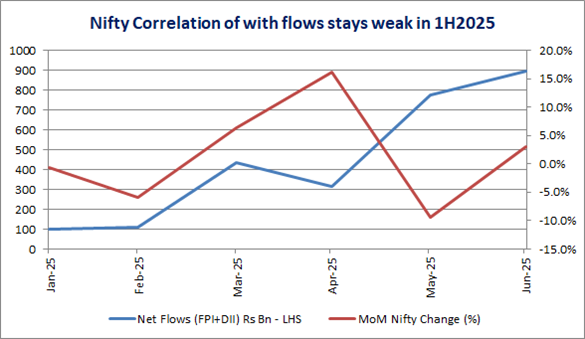
  1H2025 was marked by stressful events, high volatility, and uncertainty. In geopolitics, several conventions were breached and new doctrines established. The war between Russia and Ukraine continued. India and Pakistan had a brief but intense conflict. The US entered the Middle East (Israel-Palestine) conflict by attacking Iran. Climate wise, India had a mild winter followed by a mild summer, impacting crops. Europe continued to witness warmer weather, while the US, Canada, UK, Korea and several other countries in Africa witnessed intense and widespread wildfires, causing immense damage to the climate, lives of people and economy. Politically, the US witnessed one of the most boisterous power transitions with Donald Trump taking over as the President (POTUS). He started his second term in the White House with radical changes in immigration, trade, and climate change policies. This put the US administration on the path to confrontations with citizens, judiciary, major trade al...